Readiness Framework™
“Readiness is not simply a characteristic of the individual. It emerges from the interaction between developmental needs and contextual conditions.”
The Framework
The Map Forward Readiness Framework™ provides a practical way to understand and strengthen readiness across individuals, families, schools, organizations, and communities.
It begins with a central insight:
The same developmental logic that supports a child’s growth can also help us understand the conditions that allow families, classrooms, schools, organizations, and communities to thrive.
Although these systems differ in size, purpose, and complexity, they depend on many of the same foundational conditions for healthy functioning. Just as a child’s development is shaped by the conditions surrounding them, so too are the families, classrooms, schools, organizations, and communities in which people live, learn, work, and grow.
The framework brings together developmental needs and contextual conditions to help us understand why people and systems are sometimes available for learning, healing, adaptation, and change – and sometimes are not.
Most importantly, it helps answer a practical question:
What is limiting readiness—and where does change need to begin?
The Readiness Sequence™
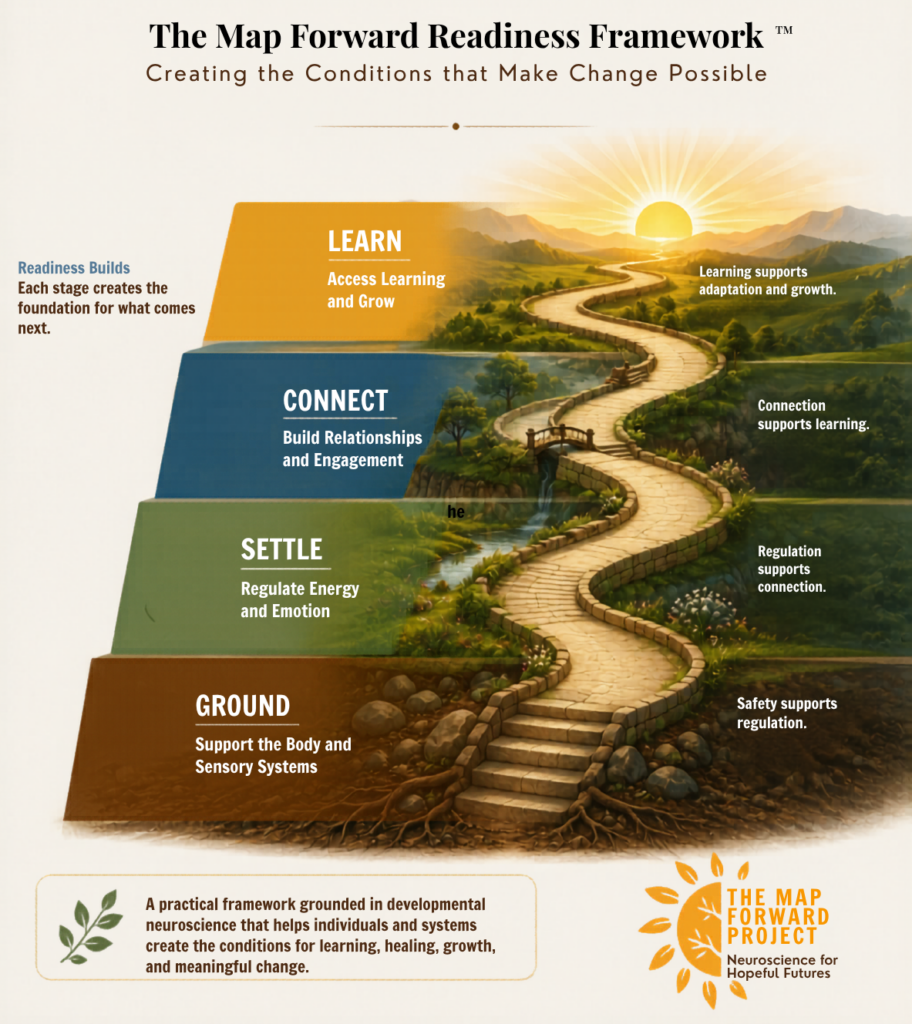
The brain develops from the bottom up. Readiness follows the same developmental trajectory, with each stage building the foundation for what comes next.
At the developmental core of The Map Forward Readiness Framework™ is The Readiness Sequence™ – a practical model grounded in developmental neuroscience that reflects the brain’s natural, bottom-up pathway to regulation, connection, learning, and growth.
Through four interconnected domains – Ground, Settle, Connect, and Learn – the sequence helps us understand what must become sufficiently organized and supported for increasingly complex functioning to emerge.
The sequence is developmental, but not rigid. People move back and forth within it depending on state, developmental history, relationships, environment, and current demands.
And developmental needs are only part of the story.
Readiness Emerges in Context
Readiness is not simply a characteristic of the individual. It emerges from the interaction between developmental needs and contextual conditions.
A child may need greater regulation, connection, or predictability – but whether those needs can be met also depends on the capacity of the adults and environments around them. The same principle applies to families, classrooms, schools, organizations, and communities.
Contextual conditions, including load, adult capacity, system capacity, relationships, stability, and continuity, can either support or constrain readiness. When demands remain within available capacity, readiness is easier to establish and sustain. When contextual load repeatedly exceeds capacity, readiness can become compromised.
This interaction is central to The Map Forward Readiness Framework™:
Developmental needs tell us what support is required. Contextual conditions influence whether that support can be provided and sustained. Readiness emerges from the interaction between the two.
This changes where we look when something isn’t working.
Rather than automatically locating the problem within the child, caregiver, teacher, employee, or organization, the framework asks us to examine the fit between developmental needs, expectations, supports, and surrounding conditions.
Sometimes the intervention needs to change. Sometimes expectations need to change. Sometimes additional support is needed. And sometimes the conditions surrounding the person must change before an otherwise appropriate intervention has a reasonable opportunity to succeed.
The right intervention can fail under the wrong conditions.
[Insert The Map Forward Readiness Framework™ graphic here]
The Four Domains of The Readiness Sequence™
Ground
Safety begins with the body.
Ground represents the physiological and sensory foundations of readiness. At the individual level, this includes sensory organization, movement, bodily rhythms, physiological stability, and sufficient felt safety.
Within larger systems, Ground is reflected in the stability, structure, predictability, and manageable demands that allow people to function effectively.
Settle
Regulation creates capacity.
Settle reflects the ability to achieve and maintain a state that is sufficiently regulated for engagement.
Regulation does not mean constant calm. It means having enough flexibility to respond to stress without becoming persistently overwhelmed, disorganized, shut down, or reactive.
Within families, schools, and organizations, Settle also draws attention to the regulatory capacity of the adults and systems surrounding the individual.
Together, Ground and Settle support Internal Readiness.
Connect
Relationships create possibility.
Human development occurs in relationship. Connect reflects trust, relational safety, belonging, co-regulation, and meaningful engagement with others.
Whether between a child and caregiver, student and teacher, colleagues, or community partners, safe and predictable relationships expand our capacity to engage, adapt, learn, and grow.
Connect supports Relational Readiness.
Learn
Growth becomes possible.
Learn represents Functional Readiness—the increasing capacity to take in information, reflect, solve problems, develop skills, change behavior, adapt, and integrate new experiences.
Learning is therefore broader than academic learning. It includes behavioral change, emotional and relational growth, healing, adaptation, problem-solving, innovation, and new ways of functioning.
Learn means becoming increasingly ready for growth and change.
One Framework. Many Applications.
Although the framework is grounded in developmental neuroscience, its usefulness extends far beyond child development.
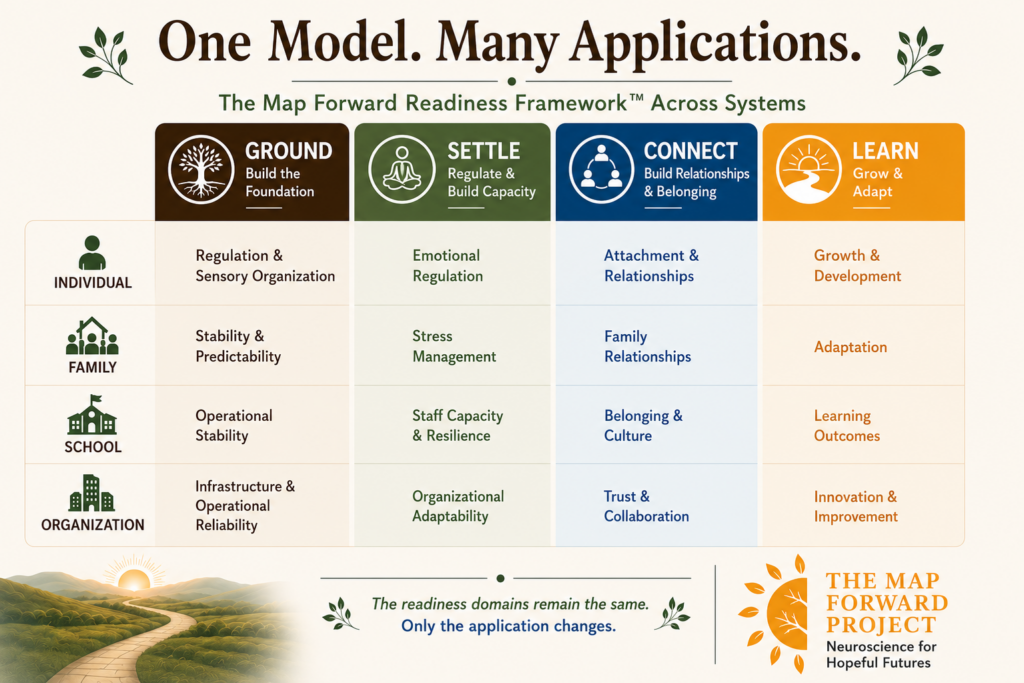
Because human systems depend upon many of the same foundational conditions, readiness can be examined across multiple levels:
Individuals – building internal regulation, resilience, connection, and capacity for growth.
Families – strengthening stability, regulation, relationships, and shared functioning.
Schools – creating conditions that support student readiness, educator capacity, and learning.
Organizations – strengthening stability, trust, adaptability, collaboration, and healthy performance.
Communities -building the conditions that support resilience, partnership, coordinated action, and collective growth.
The framework does not suggest that a family, school, organization, or community functions exactly like an individual nervous system. Rather, it recognizes that human systems are made up of people whose functioning is profoundly influenced by stability, relationships, demands, capacity, and context.
Across settings, the developmental logic remains consistent while the context, sources of load, available capacity, and strategies for strengthening readiness change.
The framework remains the same. The application changes.
Readiness in Action
When something isn’t working, our instinct is often to add more: another strategy, another service, another training, another intervention, another expectation.
Sometimes more is exactly what is needed.
But sometimes adding more simply adds load.
The Map Forward Readiness Framework™ encourages us to look beneath the visible problem and ask:
What is limiting readiness? Where does change need to begin?
A student struggling in the classroom may need a different instructional approach. But the student may first need greater sensory organization, regulation, relational safety, or predictability.
At the same time, a teacher may understand exactly what that student needs but be working within a classroom where competing demands, insufficient support, or limited capacity make providing it consistently difficult.
Both matter.
Similarly, an organization experiencing burnout may need a new strategy. But it may first need to examine whether contextual load, instability, limited capacity, or weakened relationships are preventing its people from successfully carrying that strategy forward.
Understanding readiness therefore requires looking through both lenses:
What does development require?
What does the context currently make possible?
Where is the mismatch?
And what needs to change to bring the two into better alignment?
From Understanding to Action
The practical purpose of understanding readiness is to improve what we do next.
The framework helps identify three broad pathways for intervention:
Change the conditions.
Reduce unnecessary load, increase stability and predictability, strengthen relationships, or improve the capacity of the surrounding environment.
Change the expectations.
Align demands with current readiness rather than repeatedly expecting functioning beyond available capacity.
Increase the support.
Provide sufficient regulatory, relational, developmental, or practical support to bridge the gap between current capacity and necessary demand.
Often, meaningful change requires some combination of all three.
We call this Readiness Matching: aligning developmental needs, contextual conditions, expectations, and supports so that success becomes increasingly possible.
Creating the Conditions That Make Change Possible
The Map Forward Readiness Framework™ is not another intervention, curriculum, or program.
It is a practical framework for understanding people in context and identifying where intervention is most likely to have an impact.
Rather than replacing evidence-based practices, it can help determine when, where, and how those practices are most likely to succeed by examining whether the conditions necessary to use and sustain them are sufficiently present.
This is why understanding readiness matters.
When we understand what creates readiness, we can stop simply adding strategies and begin addressing what is keeping change from taking hold.
That can lead to better intervention matching, earlier prevention, more effective use of resources, less unnecessary burden on people and systems, and more sustainable change.
An Evolving Framework
The Map Forward Readiness Framework™ continues to evolve.
Today, the framework brings together two essential dimensions of readiness: the developmental progression represented by Ground, Settle, Connect, and Learn, and the contextual conditions that influence whether those developmental needs can be met and sustained.
Future development will focus on making this interaction increasingly visible, measurable, and actionable. This includes approaches to assessing readiness and contextual load, understanding adult and system capacity, identifying readiness mismatch, and developing practical tools that help practitioners, educators, leaders, and organizations determine where intervention is most likely to create meaningful change.
The goal is not simply to understand readiness.
It is to help people and systems intentionally create the conditions that make readiness and meaningful change possible.